
PRP hair treatment Austin is one of the most sought-after non-surgical solutions for hair loss — and for good reason. Here's a quick overview to answer your most pressing questions:
QuestionQuick AnswerWhat is it?A treatment using your own blood's growth factors to stimulate hair folliclesWho is it for?Men and women with early-stage thinning or pattern hair lossHow many sessions?Typically 3-4 initial treatments, then maintenance every 3-4 monthsWhen do results show?Early signs around 2 months; optimal results at 4-8 monthsIs it safe?Yes — it uses your own blood, minimizing allergy and infection riskIs there downtime?Minimal — most people return to normal activity the same day
Hair loss is incredibly common. Around 50 million men and 30 million women in the United States experience pattern baldness at some point in their lives. For many people in Austin, Texas, that means watching their hairline gradually change — often starting in their 30s or 40s — and feeling like their options are limited to medications, harsh chemicals, or major surgery.
But regenerative medicine has changed that picture significantly.
Platelet-Rich Plasma (PRP) therapy is a non-surgical approach that uses your body's own natural healing power to stimulate dormant hair follicles and encourage new growth. A 2019 review of 11 research studies involving 262 patients found that PRP injections meaningfully reduced hair loss while increasing both hair thickness and density — particularly for those with androgenetic alopecia (the most common form of pattern hair loss).
It's not a miracle cure. But for the right candidate, it can be a genuinely effective and natural-looking solution — with no surgery, no harsh drugs, and very little recovery time.
When we talk about PRP hair treatment in Austin, we are diving into autologous therapy. "Autologous" simply means the treatment comes from your own body. Platelet-Rich Plasma is a concentrated source of your own platelets, which are the components in your blood responsible for healing and tissue regeneration.
In our blood, platelets are known for clotting, but they also contain a powerhouse of growth factors and mesenchymal stem cells. These growth factors—including PDGF (Platelet-Derived Growth Factor) and VEGF (Vascular Endothelial Growth Factor)—act as biological messengers. When injected into the scalp, they send "repair" signals to the dermal papilla cells located at the base of your hair follicles.
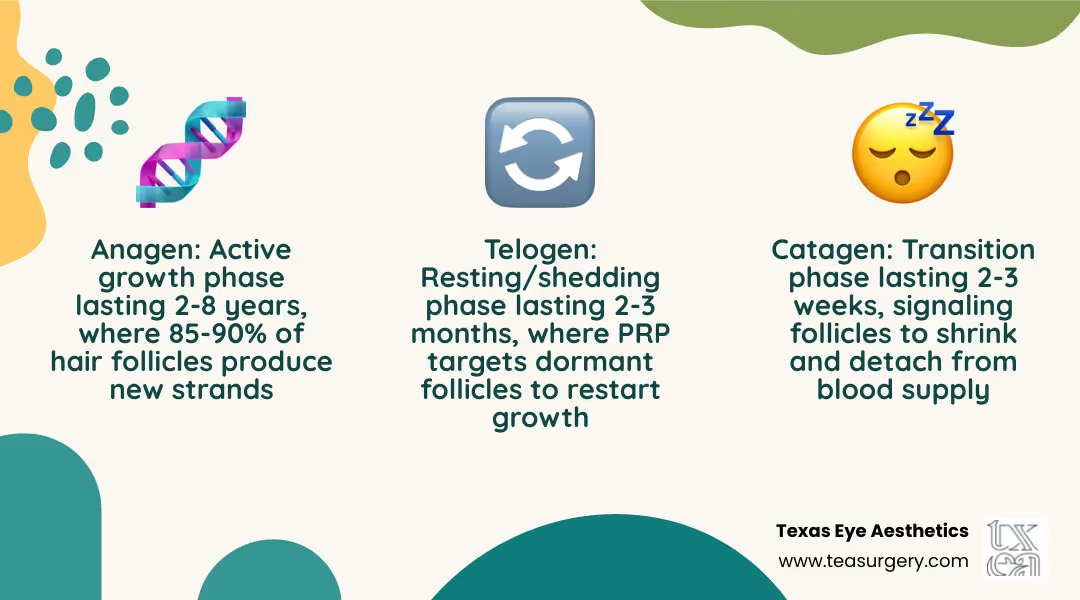
Scientific research has shown that these growth factors can effectively "wake up" dormant follicles, encouraging them to enter the active growth phase (Anagen) and stay there longer. For many of our neighbors in the Greater Austin area, this means a natural way to address thinning without relying on synthetic chemicals.
The biological "magic" of PRP happens at the cellular level. By increasing the blood supply to the hair follicle, PRP enhances the delivery of nutrients and oxygen. This is vital because many forms of hair loss, like androgenetic alopecia, involve a process called miniaturization, where the follicle shrinks over time until it can no longer produce a visible hair.
When we perform PRP hair treatment in and around Austin, the process involves:
By using a centrifuge to separate and concentrate these platelets to roughly three times their normal concentration, we create a potent serum that signals the body to regenerate tissue and support hair health.
Why are so many people in Austin, Kyle, and Round Rock choosing PRP? The benefits align perfectly with the active, health-conscious Texas lifestyle.
If you are considering PRP hair treatment near Austin, you might be wondering what a typical visit looks like. At our clinics across Central Texas—from Temple to New Braunfels—the procedure is streamlined and comfortable, usually taking between 45 and 90 minutes.
The process follows a precise three-step protocol:
While we all wish for overnight results, hair growth is a biological process that takes time. One session of PRP hair treatment Austin is rarely enough to see a dramatic transformation.
We typically recommend an initial series of 3 to 4 treatments, spaced about 4 to 6 weeks apart. This "loading phase" helps to consistently signal the follicles to remain in the growth phase.
Once the initial series is complete, maintenance is key. Because the underlying causes of hair loss (like genetics or hormones) don't go away, we usually suggest a maintenance session every 3 to 4 months to sustain the results and keep the follicles active.
Patience is a virtue in hair restoration. Here is a general timeline of what most patients in the Austin area experience:
Who makes a "good" candidate for PRP hair treatment? Generally, the best candidates are those in the early stages of hair thinning. If a hair follicle has been dormant for more than five or ten years, it may be too late to reactivate it. PRP works best on follicles that are still functional but "struggling."
Common conditions we treat include:
While PRP is incredibly safe, it isn't for everyone. You may not be a suitable candidate if you have:
One of the best things about PRP hair treatment is the ease of recovery. Most patients describe a feeling of "fullness" or a mild "tightness" in the scalp for a few hours after the injections.
Post-Procedure Tips:
When exploring PRP hair treatment, it’s helpful to see how it stacks up against other popular methods.
TreatmentHow it WorksProsConsPRP TherapyNatural growth factors from your bloodNon-surgical, zero downtime, no daily pillsRequires maintenance sessionsMinoxidil (Rogaine)Topical vasodilatorOver-the-counter, easy to findMust use daily forever; can be greasyFinasteride (Propecia)Hormonal DHT blockerVery effective for many menPotential side effects; requires a pill dailyHair TransplantSurgical graft relocationPermanent movement of hairExpensive, invasive, requires donor hair
Many of our patients find that a combination therapy approach works best. For example, using PRP to "fertilize" the scalp while using a DHT blocker to "protect" the follicles can lead to superior results compared to using just one method.
Not exactly. While the hair you grow is your own natural hair, the biological factors causing hair loss (like genetics) are still present. Think of PRP like a high-end facial or a gym routine for your scalp—you need periodic "touch-ups" every 6 to 12 months to maintain the stimulation and keep the results looking their best.
The cost varies based on the number of sessions needed and the specific protocol used. While it is more of an investment than a bottle of shampoo, many patients find the value far exceeds the cost, especially when compared to the long-term expense of medications or the high price of surgery. Most clinics offer treatment packages to make the initial series more affordable.
Most patients describe the sensation as a series of small "pinpricks" and a stretching sensation. At Texas Eye Aesthetics, we prioritize patient comfort and offer relaxing medications to help make the procedure more pleasant. The actual injection portion only takes about 10-15 minutes, and any discomfort usually fades very quickly.
At Texas Eye Aesthetics, we understand that hair loss is more than just a cosmetic concern—it’s about how you feel when you look in the mirror. Led by Dr. David Z. Gay, our team brings specialized oculoplastic and reconstructive expertise to every procedure, ensuring that your journey toward hair restoration is handled with medical precision and an eye for aesthetically pleasing, natural outcomes.
Whether you are in Austin, Buda, Temple, or Waco, we are here to help you navigate your hair restoration options with a plan tailored specifically to your needs. If you’re ready to see if PRP hair treatment near Austin is the right fit for your goals, we invite you to take the next step.


13830 Sawyer Ranch Road
Suite 201 Dripping Springs,
TX 78620
Inside Howerton Eye
4282 Farm to Market 1626
Suite 200
Kyle, TX 78640
Inside VIEW Temple
221 Paloma Drive
Temple, TX 76502
Inside New Braunfels Vision Center
1439 Hanz Drive
New Braunfels, TX 78130


