Eyelid surgery isn't just a women's procedure anymore. More men are asking about it, and most aren't chasing a dramatic change. They want to look as alert and awake as they actually feel.
Upper blepharoplasty removes excess skin (and sometimes fat) from the upper eyelid. As that skin accumulates with age or genetics, it can create a heavy, hooded look that makes you appear tired or older than you are — and in some cases, it actually crowds your field of vision. The procedure isn't about opening your eyes wider or changing their shape. It's about removing what's weighing the lid down.
According to the American Society of Plastic Surgeons' 2024 procedural statistics, men accounted for roughly 13% of the 120,755 eyelid surgeries performed that year — a meaningful share of one of the most common facial procedures in the country. Surgeons attribute the rise partly to how much time men now spend on video calls, where a heavy, hooded eyelid is more noticeable and harder to ignore than it used to be.
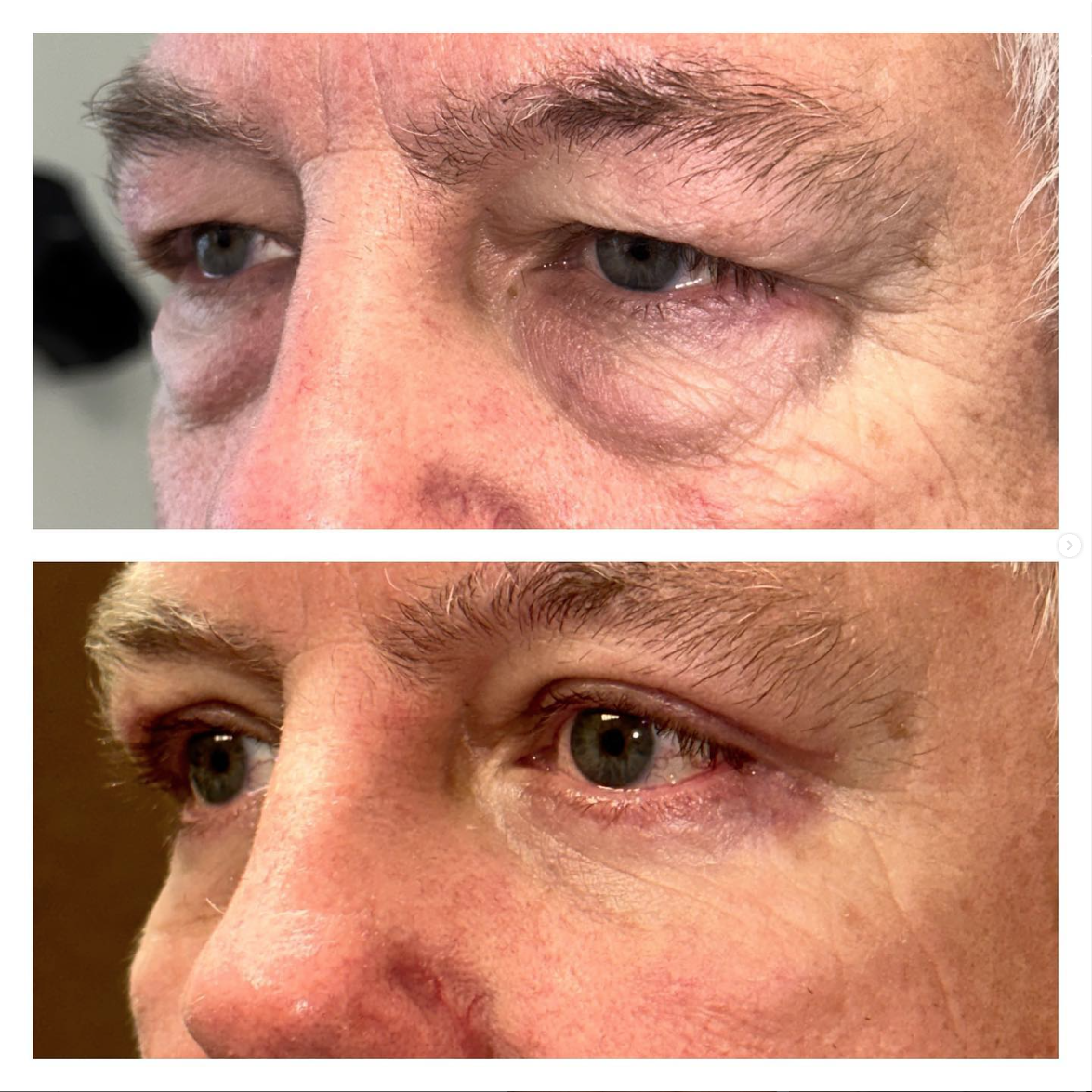
The goal for a man's upper eyelid isn't the same as it is for a woman's. A few things change:
An experienced oculofacial surgeon accounts for all of this in planning, rather than applying the same approach regardless of the patient.
Men typically consider this procedure when they notice:
Some of this is functional, not just cosmetic — when excess skin genuinely blocks vision, that's worth mentioning during consultation, since it can change how the procedure is approached and documented.
Initial healing after upper blepharoplasty is fairly quick. Most patients see visible bruising and swelling in the first week, with a noticeable improvement by 10 to 14 days — the general window cited by the American Society of Plastic Surgeons for returning to normal activity after eyelid procedures. Full settling of the eyelid contour and scar maturity takes longer, typically a few months, but most of the visible recovery happens in that first two weeks.
Will it look obvious? This is usually the top concern, and it's a fair one. The risk of an obvious result comes from removing too much skin or misjudging brow position, which is why technique and experience with male anatomy specifically matter more than the procedure itself.
Will it change my expression? Done conservatively, no. The goal is removing excess tissue, not repositioning the brow or altering your natural expression.
Is this "acceptable" for a man to do? Increasingly, yes. The data above reflects a real and growing pattern, not a niche trend — this is a mainstream procedure with a meaningful and increasing male patient base.
Dr. David Z. Gay is a board-certified oculofacial plastic surgeon with fellowship training specific to eyelid and periorbital anatomy — the kind of specialization that matters for getting male eyelid proportions right rather than defaulting to a female-standard approach. He evaluates each patient's brow position, lid crease, and vision individually rather than applying a one-size-fits-all technique.
If your primary concern is under-eye heaviness rather than the upper lid, that's a different conversation — lower eyelid concerns and upper eyelid concerns often get confused, and part of a good consultation is figuring out which one (or both) is actually behind what you're seeing.
Texas Eye Aesthetics sees patients from Dripping Springs, Kyle, Temple, New Braunfels, and Round Rock. Schedule a consultation to find out whether upper eyelid surgery fits what you're actually dealing with.
There's no fixed age. Some men in their late 30s to 40s pursue it for hereditary hooding, while many wait until their 50s or 60s when the effect on both appearance and vision becomes more pronounced.
Cosmetic upper blepharoplasty is not typically covered. When excess skin is documented to significantly obstruct vision, there may be a functional component worth discussing with your surgeon, though coverage varies and isn't guaranteed.
Results are generally long-lasting since excess skin doesn't return the same way it developed. Normal aging continues afterward, but most patients don't need a repeat procedure.
Yes, and for some men it should be. If a low, heavy brow is contributing to the hooded look rather than eyelid skin alone, addressing both at once often gives a more complete and balanced result than either alone.


13830 Sawyer Ranch Road
Suite 201 Dripping Springs,
TX 78620
Inside Howerton Eye
4282 Farm to Market 1626
Suite 200
Kyle, TX 78640
Inside VIEW Temple
221 Paloma Drive
Temple, TX 76502
Inside New Braunfels Vision Center
1439 Hanz Drive
New Braunfels, TX 78130


