If you're searching for brow lift before and after results, you're probably trying to answer one question: will this actually look like me, just more rested? That's the right question. A well-done brow lift doesn't change who you are in the mirror — it just removes the heaviness that makes you look tired, annoyed, or older than you feel.
A brow lift (also called a forehead lift) repositions the eyebrows and smooths the tissue of the forehead. As brows drop with age, they can crowd the upper eyelids, deepen forehead lines, and create an expression that doesn't match how you actually feel. The procedure lifts the brow back into a natural position and softens those lines — it doesn't stretch the skin tight or change your facial structure.
Good candidates typically notice:
- Brows that sit lower than they used to, especially at the outer corners
- Upper eyelids that look heavy or hooded, even without excess eyelid skin
- Deep horizontal forehead lines or vertical lines between the brows
- A resting expression that reads as tired, angry, or sad — even when you're neither
Not everyone with these concerns needs a brow lift. Sometimes what looks like brow drooping is actually upper eyelid skin excess, which is a different procedure (blepharoplasty). Part of a good consultation is figuring out which one — or both — is actually causing what you're seeing in the mirror.
There isn't one version of this surgery. The right approach depends on how much lift is needed and where.
Endoscopic brow lift uses three to five small incisions hidden in the hairline, with a camera guiding the surgeon underneath the skin. It's the most common approach for patients who want a full, natural repositioning of the brow with minimal visible scarring.
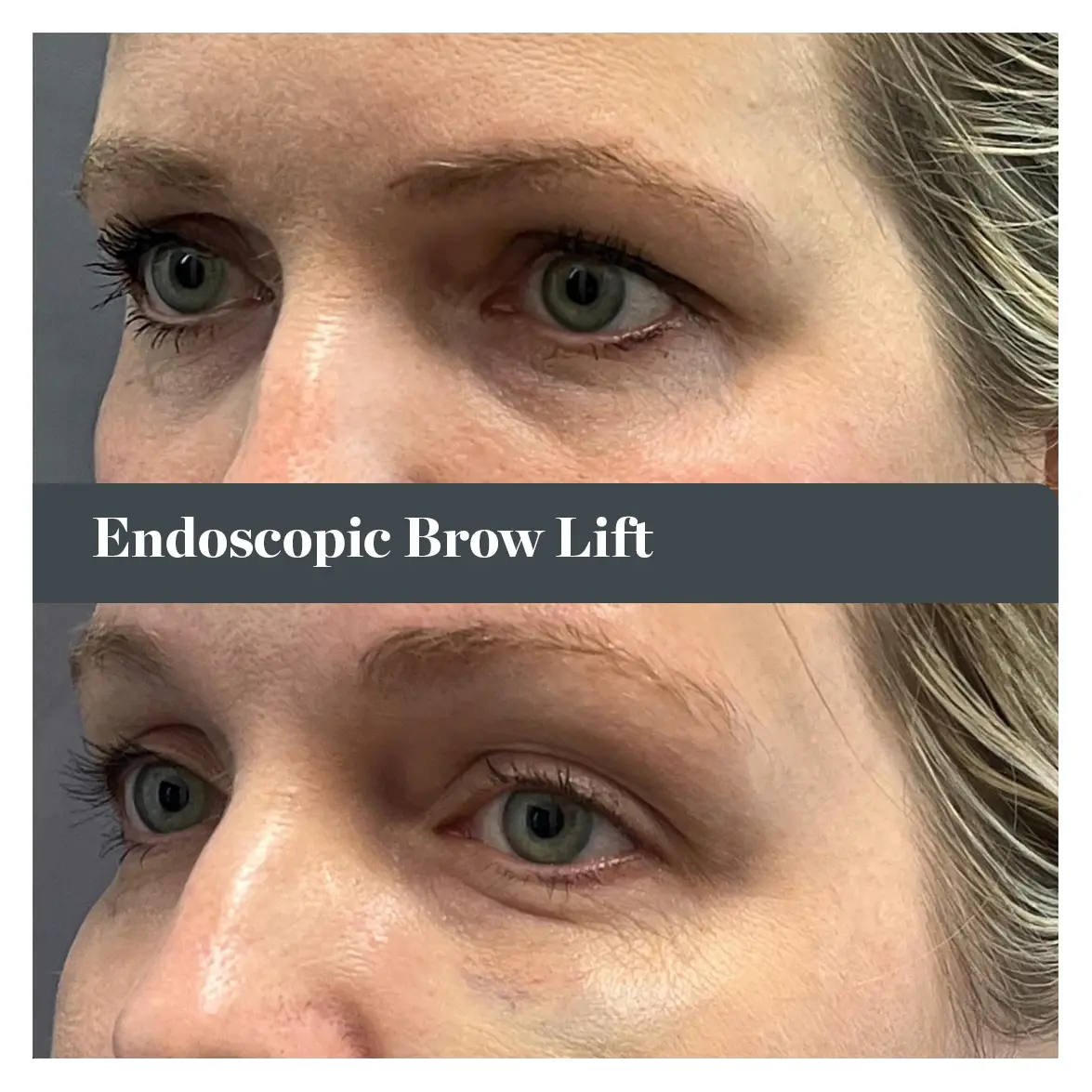
Temporal (or lateral) brow lift focuses on lifting just the outer third of the brow — useful when the main concern is heaviness at the outer eye rather than the whole forehead.

Direct or internal brow lift places a smaller incision right above the brow or is combined with upper eyelid surgery. It's often a good fit for patients who need a more targeted lift, particularly when vision is affected by heavy brows.

Dr. Gay determines the right technique based on your anatomy and goals during consultation.
According to the American Society of Plastic Surgeons, initial wound healing after a brow lift takes about 10 to 14 days, and most patients return to work and normal activity in that same window. Swelling and bruising are heaviest in the first week and improve steadily from there, though residual swelling in the forehead can take up to six months to fully resolve as the brow settles into its final position.
Temporary numbness in the forehead or scalp is common in the early weeks and typically fades over a few months as sensation returns.
The result itself tends to be subtle in the best way. A 2024 study using AI-based age estimation found that brow lift patients showed a statistically significant perceived age reduction of about 1.7 years on average. A modest, believable change, not a dramatic one. That's consistent with what "natural-looking" actually means clinically: friends notice you look more rested without being able to say exactly why.
How to choose the right surgeon
The most important factor isn't the technique — it's who's doing it. Look for board certification, specific training in eyelid and brow anatomy, and a real before-and-after gallery you can review. We've written a full breakdown of what to look for in how to choose a surgeon for eyelid and brow surgery if you want the complete list of questions to ask.
Dr. David Z. Gay is a board-certified oculofacial plastic surgeon with fellowship training specifically in eyelid, orbit, and facial aesthetic and reconstructive surgery — a level of specialization in this exact anatomy that general plastic surgeons and dermatologists don't have. He performs endoscopic, temporal, and direct brow lift techniques, often in combination with blepharoplasty for patients who need both addressed at once.
If you're not ready for surgery, non-surgical options like Botox can offer a temporary, more subtle brow lift effect worth discussing during consultation.
Texas Eye Aesthetics sees patients from Dripping Springs, Kyle, Temple, New Braunfels, and Round Rock. Schedule a consultation to find out which technique fits your anatomy and goals.
Results are generally long-lasting, though the natural aging process continues afterward. Most patients maintain their result for many years, especially with good sun protection and stable weight.
That's the goal of a natural-looking lift — friends and coworkers typically notice you look more rested or alert, not that you've had a procedure. Overcorrection is what creates the "surprised" look, which is why technique and experience matter.
Yes, and it often should be. Heavy brows and excess upper eyelid skin frequently occur together, and addressing both at once tends to give a more balanced result than treating either alone.
Cosmetic brow lifts are not typically covered by insurance. In cases where drooping brows are significantly obstructing vision, there may be a functional component worth discussing with your surgeon.


13830 Sawyer Ranch Road
Suite 201 Dripping Springs,
TX 78620
Inside Howerton Eye
4282 Farm to Market 1626
Suite 200
Kyle, TX 78640
Inside VIEW Temple
221 Paloma Drive
Temple, TX 76502
Inside New Braunfels Vision Center
1439 Hanz Drive
New Braunfels, TX 78130


