A brow lift is one of those procedures patients spend years researching before they finally book a consultation. Recovery is usually the last question that gets answered, and it is the one that determines whether the timing actually works for your life. Here is what to expect after a brow lift, week by week, with the kind of detail that helps you plan around it.
Brow lifts are not all the same procedure. Depending on your anatomy and the goal of the surgery, your surgeon may recommend an endoscopic brow lift (small incisions hidden behind the hairline), a temporal or lateral brow lift (incisions limited to the area near the temple), a direct or internal brow lift (often performed alongside upper blepharoplasty), or a coronal lift (a longer incision used selectively for specific cases).
Recovery overlaps significantly across techniques, but the smaller and more targeted the incisions, the faster the surface-level healing. The numbers in this guide reflect a typical endoscopic or temporal brow lift, which are the most common approaches today.
Swelling and bruising peak between 24 and 72 hours after surgery, often most noticeable on the second day. According to the American Society of Plastic Surgeons, most of the swelling rapidly subsides after the 48-hour mark, although fullness in the forehead and around the eyes is normal in the first few days.
Plan on rest, cold compresses on the schedule your surgeon provides, and sleeping with your head elevated at roughly a 30-degree angle. The elevation matters more than people expect because gravity is one of the simpler tools in your recovery toolkit. Avoid bending forward or lifting anything heavier than a glass of water during this window.
Mild discomfort and tightness in the forehead are normal. Most patients are off prescription pain medication within a day or two and managing well with acetaminophen.
The first full week is mostly about protecting the work that was done. Swelling and bruising soften day by day, and bruising often migrates downward toward the cheeks before fading. That is normal. The skin around the eyes can take on a yellow-green tint as the bruising resolves, which becomes easier to camouflage with light makeup once your surgeon clears it.
Sutures are typically removed at the end of week one. Most patients feel comfortable being seen in public by day seven to ten, although the forehead may still feel tight or slightly numb. Numbness is common, and it usually resolves over weeks to a few months as nerves recover.
What to skip in week one: heavy lifting, bending at the waist, hot showers, saunas, hot yoga, and any cardio that elevates your heart rate. Light walking is encouraged because circulation supports healing.
By week two, the visible bruising is mostly gone or easily covered. Sutures are out. Swelling continues to soften, and the brow position begins to look more refined and less surgical.
Most patients return to non-physical work between days ten and fourteen, depending on the visibility of their job and how comfortable they feel. Light makeup is typically fine by this point. You can resume most daily activities, drive comfortably, and start planning lower-impact workouts.
Strenuous exercise, weightlifting, and anything that raises blood pressure significantly are still off-limits. Most surgeons clear those activities at three to four weeks.
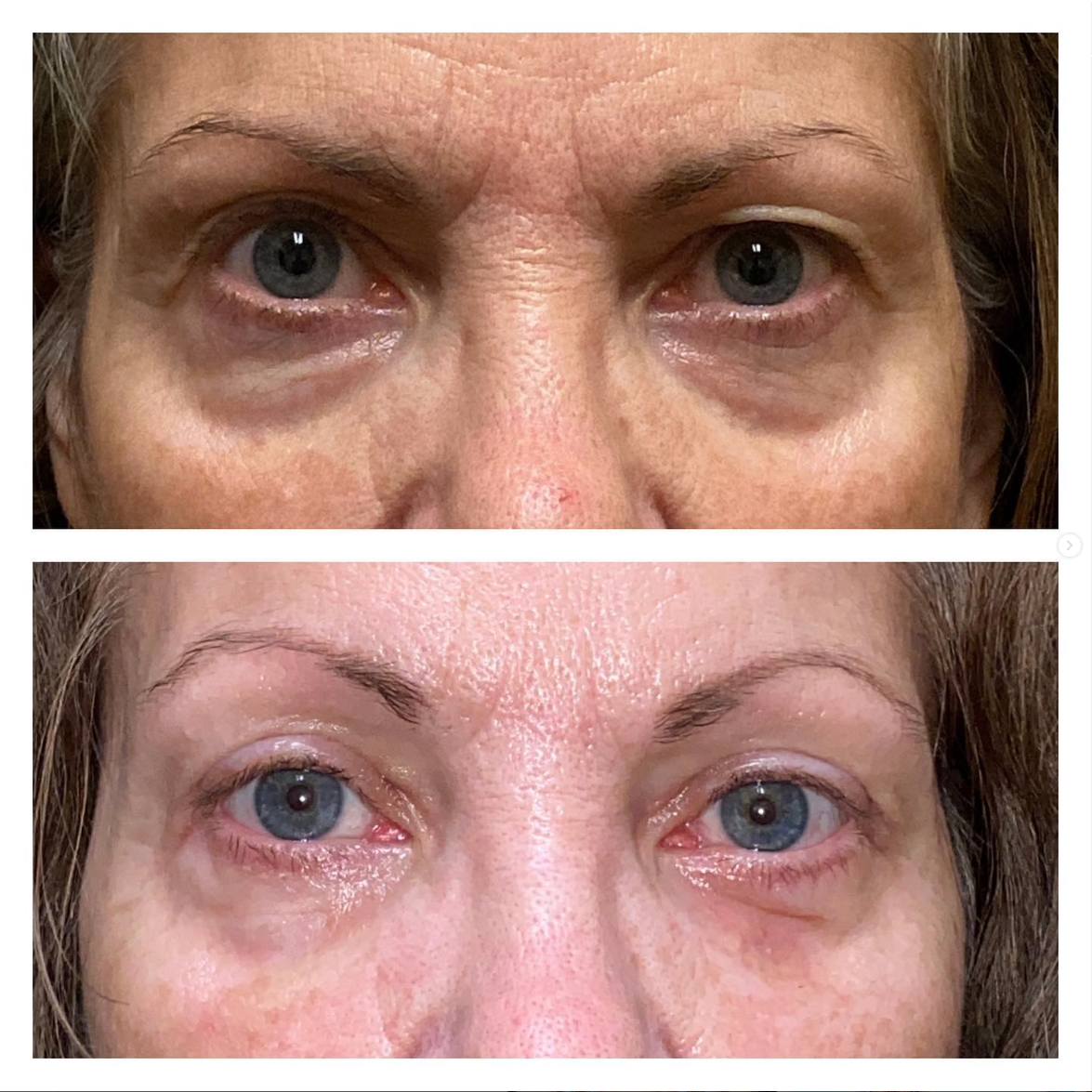
By weeks three and four, most patients describe themselves as looking well-rested rather than visibly post-op. The brow position has settled, the small incisions are flattening, and any remaining swelling is subtle and usually only visible to you in the mirror.
This is the window where most patients return to the gym, easing back into cardio, then strength training as cleared by their surgeon. Sun protection during this phase is critical. Fresh scar tissue (even tiny incisions hidden in the hairline) is sensitive to UV, and protection now prevents pigmentation changes later.
If you wear glasses or sunglasses, the temple area may still feel slightly tender for a few weeks. Lighter frames help. So does taking them off when you do not need them.
The visible bruising and swelling are gone by the second month, but the final result of a brow lift continues to refine over the next four to six months. Per ASPS, residual swelling can take up to six months (and occasionally up to a year) to fully resolve, particularly in the forehead. The brow position continues to settle into its long-term placement during this window.
Numbness in the forehead or scalp, common in the early weeks, typically resolves over a few months as the small sensory nerves regenerate. Some patients notice subtle changes in skin sensation that fade gradually rather than disappearing all at once.
By six months, the result is essentially what you will live with. Most patients describe the change as looking more open, more rested, and more like themselves, which is the goal of a well-executed brow lift.
The most comfortable recoveries tend to share a few habits. Sleeping elevated for the first ten to fourteen days. Strict adherence to the cold compress schedule in the first 72 hours. Avoiding blood thinners (including ibuprofen, aspirin, fish oil, and certain supplements) before and after surgery, per your surgeon's instructions. Skipping alcohol for the first week.
The patients who struggle most are usually the ones who try to compress recovery, return to workouts too early, or skip head elevation. Healing is not a contest. The two extra weeks of patience often save months of refinement.
Most surgeons clear gentle hair washing at 48 to 72 hours, with specific instructions about avoiding the incision sites. Vigorous scalp massage and heat are off the table for at least two weeks.
Endoscopic and temporal brow lift incisions are small and placed within or just behind the hairline, where they become very difficult to see as they mature. Direct brow lift incisions are placed in the natural skin lines above the brow and fade significantly over months.
Most of the visible result is in place by three months. Subtle refinement continues through six months. By the one-year mark, you are looking at the long-term outcome.
If a brow lift has been on your radar, the most useful next step is an in-person consultation. Dr. David Z. Gay is a board-certified ophthalmologist with fellowship training in oculofacial plastic and reconstructive surgery, and the practice is built around natural-looking results that hold up to a close look. Browse the brow lift before and after gallery for a sense of the range of outcomes, then schedule a consultation online or call our Dripping Springs office at 512-607-6884.


13830 Sawyer Ranch Road
Suite 201 Dripping Springs,
TX 78620
Inside Howerton Eye
4282 Farm to Market 1626
Suite 200
Kyle, TX 78640
Inside VIEW Temple
221 Paloma Drive
Temple, TX 76502
Inside New Braunfels Vision Center
1439 Hanz Drive
New Braunfels, TX 78130


